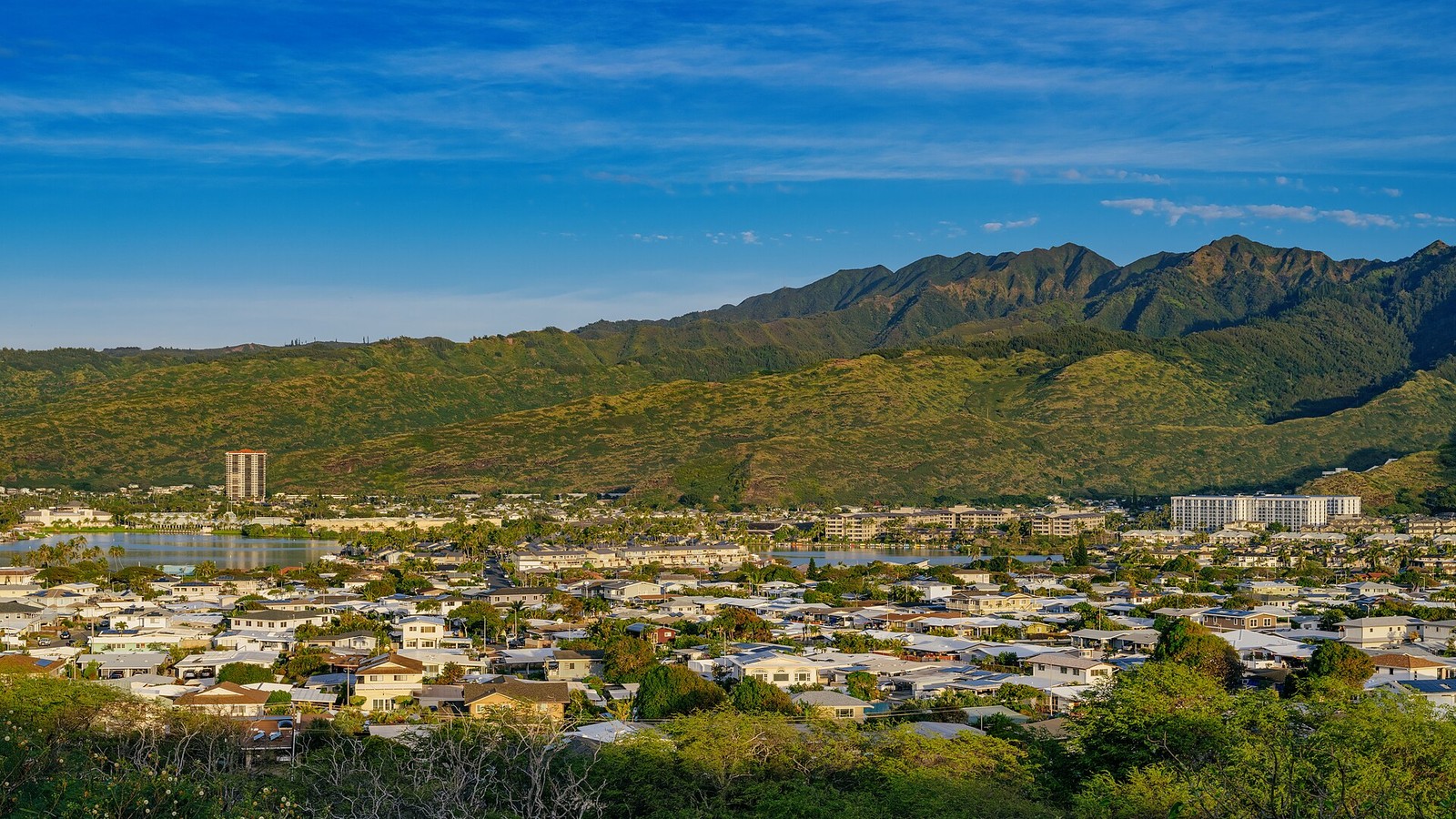
Homes in Hawaii Kai, looking toward the Koolaus. Photo: Tony Webster, Wikimedia Commons, CC BY 2.0 (cropped).
By Tony Kawaguchi, REALTOR · Updated November 22, 2026
The short answer: The AI debate is the setup, not the conclusion. After the dot-com crash, the Federal Reserve cut the federal funds rate from 6.50% to 1.00%. The average 30-year mortgage fell from 8.05% in 2000 to 5.83% in 2003. In those same years, the S&P Case-Shiller national home-price index rose 28.3%, and Oahu's median single-family price rose from $295,000 to $380,000. Buyers here have been living with high rates since 2022, and most are still waiting for them to come down. If a tech unwind leads to lower rates, that is the history I would study. It is not a promise that the same thing happens again.
When I sit down with a buyer on Oahu now, the first question is usually about mortgage rates, not about a particular street. That has been true for about four years. What has changed this year is the noise around artificial intelligence: some very serious investors say the spending boom looks like a bubble, and they are pointing at how the money is circulating among the same companies.
I am a Hawaii REALTOR, not a securities analyst. I will not pretend I can time a stock-market peak, and I am not predicting that any named company is going bankrupt. What I can do is put those warnings next to something we can actually measure: what happened to interest rates and housing after the last big technology bust, in 2000, and how that compares with the slow market buyers have been waiting through since 2022.
What serious voices are actually saying about an AI bubble
This summer and fall, Steven Bartlett walked through the question on The Diary Of A CEO with more than one guest. I went back to the published transcripts, not to clips, so the wording below is theirs.
On the June 25, 2026 episode, titled "The Crash Is Already Here," investor Jeremy Grantham said artificial intelligence "is right up there with the railroads" and "it's going to change everything." That, in his view, is exactly how a bubble forms. The great bubbles, he said, gather around important ideas, not scams. Then he said, "If you look at the data, it would be compatible with history for the peak to be very soon. Everything is in line. This is, I think, the biggest investment bubble in American history." He added that the stocks that have gone up the most, "AI and the more exciting stocks with the biggest moves," would historically be expected to fall the most: "From these unprecedented levels, a 70% decline would not be unexpected."
On July 30, 2026, in "Ray Dalio: I Predicted The 2008 Crash, I Know What Comes Next," Bartlett played that Grantham clip for Ray Dalio, the founder of Bridgewater Associates. Dalio's first reply was, "He's right." He compared the moment to the 1929 bubble and "the 2000 bubble, which is the dot-com bubble." His point was not that the technology is fake. He said we should be excited about AI "because it's got to be revolutionary changes." The mistake, he said, is that people "lose sight that the price of it matters" and "don't pay attention to the price," sometimes even borrowing to bet on it.
On October 26, 2026, in "Mark Cuban: The Next Market Crash Is Where The Real Money Is Made!," Cuban took the argument into the credit market. "We literally could get into a debt bubble in the United States of America because there's so much debt being taken out by all these hyperscalers," he said. "The hyperscalers are borrowing more than they're making." If rates keep rising on a large pile of debt, he said, "at some point, you can't raise money anymore."
Those are their views, recorded on specific dates. They are the presupposition for this post, not a forecast I am making in my own name.
Nvidia's circular funding, and the failure risk some experts flag
The part of this boom that should make any buyer or seller slow down and read the footnotes is the circular funding. A chip supplier puts money, or a guarantee, behind a customer. The customer then uses that support to buy the supplier's chips. Both sides can show growth. The open question is how much of the demand is coming from end users, and how much is the same capital going around the circle.
The documents are public. On February 27, 2026, OpenAI announced $110 billion in new investment at a $730 billion pre-money valuation, including $30 billion from Nvidia. The same announcement expanded the Nvidia partnership to 3 gigawatts of dedicated inference capacity and 2 gigawatts of training on Nvidia's Vera Rubin systems, on top of systems already running across Microsoft, Oracle's OCI, and CoreWeave.
On August 17, 2026, Nvidia filed an 8-K and issued a press release on a larger backstop. Nvidia is guaranteeing residual lease value at SB Energy's PORTS-Pike campus in Pike County, Ohio, with OpenAI as the tenant. Nvidia's aggregate payment obligation under the initial commitment is capped at $105 billion, and the campus is to use Nvidia's full-stack DSX platform, including GPUs, CPUs and networking, subject to limited exceptions. Nvidia also said it would invest $1.5 billion in SB Energy. In plain terms, Nvidia is helping finance a project that is then expected to be filled with Nvidia equipment.
On the October 26 episode, Cuban, who called himself a huge fan of Nvidia, said the company is "basically subsidizing half the industry because they have the cash to do it." That is his characterization, not a finding by me.
Where does the bankruptcy talk come from? Not from me, and not from a filing that says a specific company has failed. It comes from people who have been watching the credit. In a November 16, 2026 interview with CNN, former Securities and Exchange Commission Chair Gary Gensler said, "It's already a bubble." He pointed to circular deals and how the buildout is financed, and said, "I think history will show that they loaned too much money, too fast." He did not say the largest technology companies were about to disappear. He said, "The major companies will survive. It's these neocloud companies where we're going to see some breakage and bankruptcies." Neoclouds, in that interview, are the specialist firms that lease high-performance computing to AI developers. I am repeating his warning, not adopting it as a prediction about any one name.
A residential tower in Kakaako. Photo: Warren LeMay, Wikimedia Commons, CC BY-SA 2.0 (cropped). Building address omitted.
After the 2000 crash, rates fell and housing rose
Here is the part I want Oahu buyers and sellers to sit with. In 2000, the bubble that burst was in technology stocks, not in houses. The Federal Reserve had raised its federal funds target to 6.50% on May 16, 2000. After the tech bust, and then a recession and the September 2001 attacks, it cut aggressively: 11 times in 2001, from 6.50% down to 1.75% on December 11, 2001, according to the Fed's own open-market operations archive. It cut again, to 1.25% on November 6, 2002, and to 1.00% on June 25, 2003, which the FOMC announced that day.
Mortgage rates followed, though not dollar-for-dollar with the funds rate. Freddie Mac's Primary Mortgage Market Survey, the same weekly average we still use, shows a 30-year fixed average of 8.05% in 2000, 6.97% in 2001, 6.54% in 2002, and 5.83% in 2003. The weekly low in that stretch was 5.21%, reported for June 13, 2003, in the official survey file and later confirmed in an OFHEO review of that year.
Home prices went up, not down, while that easing was underway. The S&P Case-Shiller U.S. National Home Price Index, which is set to 100 in January 2000, stood at 108.793 in December 2000 and 139.629 in December 2003, per the FRED series CSUSHPINSA (updated October 27, 2026). That is a 28.3% rise in three years.
Oahu was not a sideshow. Honolulu Board of REALTORS annual figures, published by HiCentral, show the median single-family resale at $295,000 in 2000, $299,900 in 2001, $335,000 in 2002, and $380,000 in 2003, a 28.8% increase from 2000 to 2003. The condo median went from $125,000 to $175,000, a 40% increase. Sales rose with the prices: 7,107 combined single-family and condo resales in 2000, and 11,326 in 2003.
| Year | Fed funds target, year-end | PMMS 30-year average | Case-Shiller U.S. index, December | Oahu SFH median | Oahu condo median |
|---|---|---|---|---|---|
| 2000 | 6.50% | 8.05% | 108.793 | $295,000 | $125,000 |
| 2001 | 1.75% | 6.97% | 116.055 | $299,900 | $133,000 |
| 2002 | 1.25% | 6.54% | 127.153 | $335,000 | $152,000 |
| 2003 | 1.00% | 5.83% | 139.629 | $380,000 | $175,000 |
Fed funds from the Federal Reserve's open-market archive (2003 year-end is the June 25, 2003 target of 1.00%, which was held into 2004). Mortgage averages are calendar-year means of weekly Freddie Mac PMMS 30-year rates. Case-Shiller is the not-seasonally-adjusted national index, January 2000 = 100, December values. Oahu medians are Honolulu Board of REALTORS annual resale figures via HiCentral.
Two caveats belong next to that table. First, the Fed was not cutting only because the NASDAQ fell. It was also responding to a recession and to the shock of 2001. Second, this did not last forever. The cheap-money years after 2003 helped set up a very different crisis in 2008, which I will come back to. The narrow point still stands: in the years right after the 2000 crash, rates fell and housing rose, including here.
This market has been slow for four years, and buyers are still waiting on rates
That history matters because of the market we are in now. The 30-year average was 3.22% in the Freddie Mac survey for January 6, 2022. It reached 7.08% by October 27, 2022. It has not returned to the old 3% neighborhood. As of November 19, 2026, the latest weekly figure, the 30-year averaged 7.28%, up from 7.11% the week before and above the 6.26% reading from a year earlier.
Sales volume on Oahu shows the stall. Combined single-family and condo resales peaked at 11,729 in 2021, then fell to 9,827 in 2022 and 7,133 in 2023. They have barely moved since: 7,252 in 2024 and 7,298 in 2025, still about 38% below the 2021 total, per the same HiCentral annual series. My October 2026 market recap did not change that picture. Condo sales that month were down 23.5% from a year earlier, and year-to-date condo sales were still behind 2025's pace, even as single-family sales ran a little ahead.
Prices did not crash with the volume. The Oahu single-family median was $1,105,000 in 2022 and $1,139,000 in 2025. In October 2026 it was $1,150,000. Buyers did not get a bargain just by waiting, and a lot of them have kept waiting anyway.
That is not only my impression from listing appointments. U.S. News & World Report's 2026 Spring Homebuying Survey, conducted April 20-24, 2026 among 1,207 people nationwide who planned to buy a home that year with a mortgage, found that 62% were waiting for mortgage rates to fall before they bought. That was down from 80% in the 2025 survey, so some people have given up on the wait, but it was still a majority. Among those who postponed a purchase in 2025 while they waited for rates to drop, 41% said they regretted it.
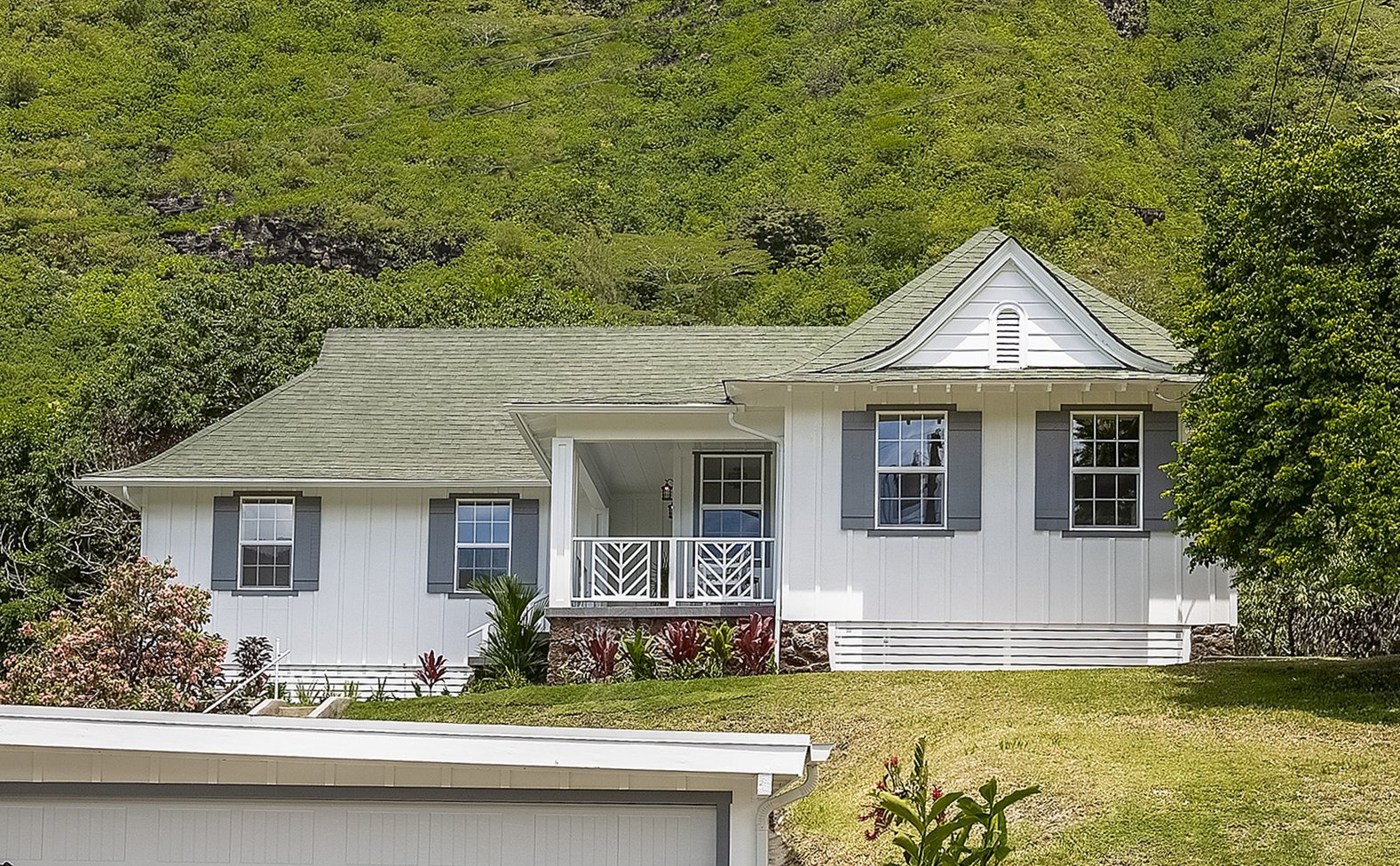
One of my listings in Manoa.
Why 2008 is the wrong comparison
Whenever someone says "bubble" and "housing" in the same sentence, 2008 is the memory that shows up. It is the wrong rhyme for this story.
In 2008, housing itself was the bubble. Loose lending, weak underwriting, and a belief that home prices only went up sat at the center of the crash. When that broke, mortgage credit seized up and prices fell. On Oahu, the single-family median dropped from $643,500 in 2007 to $575,000 in 2009, and total resales fell from 9,126 to 6,052, according to the same HBR annual figures.
In 2000, the bubble was in technology stocks. Housing was not the asset that popped first. The policy response was easier money, and house prices rose. If AI spending unwinds, the first hit, if there is one, would more likely show up in equities, credit, and then in the interest-rate path, not automatically in the median price on Oahu. I cannot tell you the Fed will cut this time. Inflation, the job market, and the federal deficit can all get in the way. I can tell you that "tech bubble equals housing crash" is not what the 2000-2003 data show.
What I'd tell an Oahu buyer or seller right now
I would not make a home decision based on a podcast, including the ones I just quoted, and I would not wait for a stock-market crash to "fix" affordability. A house you can live in and pay for has to make sense on today's rate, today's payment, and today's comparable sales.
If you are buying, run the payment at 7.28% and at a lower rate, so you know what a cut would change. Do not count on the lower number. If a tech unwind does pull rates down, the 2000-2003 lesson is that you may be competing with more buyers, not fewer, once financing gets cheaper. That is when inventory gets used up and prices can move higher, not when they necessarily go on sale.
If you are selling, the last four years already told you that a high asking price and a high rate are a hard pair. If rates fall, more buyers can qualify, but they will still compare your home with everything else they can finally afford to tour. Price it like it has to sell in this market, not in a hoped-for one.
History does not guarantee a repeat. The 2001 cuts had other causes besides a falling NASDAQ. Today's inflation and debt picture is not a copy of 2001. And the years after 2003 are a reminder that very low rates can create problems of their own later. Still, if you have been standing on the sidelines for four years waiting for lower rates, the last time a major technology boom broke, lower rates arrived, and housing went up. That is the comparison I want you to have, with the caveats attached, before anyone tells you a different story.
FAQ
Has the AI bubble already burst?
Not as a settled fact I can point to. As of November 22, 2026, the warnings I quoted are just that: warnings from Grantham, Dalio, Cuban, and Gensler, recorded between June and November. I am not calling a peak, and I am not telling you to trade stocks around one.
If tech stocks fall, do Oahu home prices have to fall too?
No. After the 2000 crash, national home prices and Oahu medians rose while the Fed was cutting and mortgage rates were falling. A stock decline can still slow the economy or shake consumer confidence. It does not automatically take house prices with it, especially if the policy response is lower rates.
Why wasn't 2008 like 2001?
Because in 2008 the bubble was housing and the mortgages used to buy it. In 2000 the bubble was technology stocks. Different asset, different credit problem, different result for home prices in the years immediately after.
Are buyers really waiting on mortgage rates?
Yes, in the most recent national survey I could check. U.S. News found 62% of intended 2026 mortgage buyers were waiting for rates to fall, down from 80% in 2025, but still a majority. On Oahu, sales have been stuck well below 2021 levels since 2023, which matches a market where many people can stay in place and wait.
Should I wait to buy on Oahu if rates might drop?
Only if the home does not work at today's payment. If rates do fall, the 2000-2003 record is that prices can rise as financing gets easier. Waiting has already cost some people time, and 41% of those in the U.S. News survey who postponed a 2025 purchase while waiting on rates said they regretted it. This is not a recommendation to buy or to wait. It is a reminder to underwrite the house you are actually looking at.
What would you tell a seller who wants to hold out for lower rates?
You can hold out, but you are making a bet on both rates and competition. If rates fall and more buyers come back, well-priced homes should do better. A house that is already ahead of the comps may still sit. I would rather be priced to the market we have and be ready if demand improves than sit at a number that only works in a different rate world.
This is general information, not legal, tax, insurance, financing or investment advice. Interest rates, home prices and company finances change. Confirm anything that affects a purchase, a sale or an investment with the appropriate licensed professional.
Sources: Jeremy Grantham, The Diary Of A CEO, "The Crash Is Already Here," June 25, 2026 (published transcript); Ray Dalio, The Diary Of A CEO, "Ray Dalio: I Predicted The 2008 Crash, I Know What Comes Next," July 30, 2026 (published transcript; Spotify episode); Mark Cuban, The Diary Of A CEO, "Mark Cuban: The Next Market Crash Is Where The Real Money Is Made!," October 26, 2026 (published transcript); Gary Gensler, interview with CNN, November 16, 2026, as reported by Mortgage Professional America and contemporaneous news accounts; OpenAI, "Scaling AI for everyone," February 27, 2026; NVIDIA Corp. Form 8-K, August 17, 2026; NVIDIA press release, August 17, 2026; Federal Reserve, Open Market Operations Archive; FOMC statement, June 25, 2003; Freddie Mac Primary Mortgage Market Survey historical weekly file and PMMS results as of November 19, 2026; OFHEO, "Mortgage Markets and the Enterprises in 2003," October 2004; S&P Cotality Case-Shiller U.S. National Home Price Index (CSUSHPINSA), FRED, updated October 27, 2026; Honolulu Board of REALTORS annual residential resales, HiCentral; Honolulu Board of REALTORS, October 2026 release, November 6, 2026; U.S. News & World Report, 2026 Spring Homebuying Survey.
Tony Kawaguchi, REALTOR, The Kawaguchi Group, eXp Realty
If you want to talk through what a rate change would do to a specific Oahu purchase or sale, call or text me at (808) 201-3577.